Natural fibers · Pillow construction
From Seed Pod to Pillow: How Kapok Filling Is Prepared
A kapok pillow begins far from the bedroom: inside a pod on a tropical tree. Between that origin and the finished pillow, a light, silky fiber must be gathered, separated from seeds, cleaned, and enclosed in a construction that can make the most of its buoyancy.
Published October 16, 2026
At first glance, the story of kapok seems straightforward. A tree produces a pod; the pod opens; pale fibers emerge; someone puts them in a pillow. The reality is more interesting. Kapok’s feel and performance are shaped by a chain of natural events and practical decisions: when pods are collected, how fibers are separated, how they are kept dry, and how a pillow’s shell contains a filling that is unusually light and springy.
Kapok is a plant fiber associated with the seed pods of kapok trees, particularly Ceiba pentandra. It has a long history of use in cushions, bedding, and other padded goods. Its appeal is easy to understand once the fiber is handled: it feels soft and airy, and a small quantity can occupy surprising space. Those qualities help explain why kapok pillows are often described as lofty or buoyant—and why making one involves different choices from constructing a pillow with dense, washable filling.
This guide follows the material from pod to pillow insert. It also distinguishes what the fiber can do from what a pillow maker must design around it. Kapok is not a magic ingredient that guarantees a particular sleep experience. The cover, amount of filling, distribution, sewing, and care all matter. Understanding those details gives readers a clearer way to evaluate natural pillow materials without confusing attractive language with evidence.
A fiber hidden in a pod
The kapok tree produces elongated seed pods. As pods mature and open, they reveal a mass of fine fibers surrounding the seeds. The fibers help create a protective, buoyant covering around the seeds and can assist their movement away from the parent tree. In practical terms, that means the material begins as part of a plant’s reproductive structure—not as a textile spun from a long, continuous strand.
That distinction matters. Cotton, for example, is also harvested from a seed-associated structure, but cotton fibers are commonly processed and spun into yarn. Kapok’s individual fibers are typically short, slick, and difficult to spin using ordinary textile methods. In pillow construction, they are more often used as loose filling, where their ability to occupy space is useful and there is no requirement to turn them into a woven thread.
Descriptions of kapok frequently emphasize its light weight and softness. These are meaningful qualities, but they do not tell the whole story. The fiber’s structure, the condition of the harvested material, the way it is prepared, and the way it is packed into a casing influence how a finished pillow feels. A pillow’s firmness, for instance, cannot be inferred from the word “kapok” alone.
Nor does “natural” automatically mean identical from one batch to another. Agricultural conditions, maturity, handling, and preparation can all affect raw plant materials. For a consumer, the most useful questions concern what a maker actually specifies: the fill composition, whether the fill can be adjusted, the cover fabric, and the recommended care instructions.
The journey from harvest to usable filling
There is no single universal processing recipe for every source of kapok. Methods can vary by region, scale, equipment, and intended use. Still, the broad stages are easy to follow: mature pods are gathered, opened, and separated so that the useful fiber can be collected apart from seeds and other debris. The material may then be sorted and prepared for storage or use in a product.
1. Collecting mature pods
Preparation begins with the plant and its growing cycle. Pods need to mature before they open and expose their fiber. Collection practices depend on local conditions and how the crop is managed. Once gathered, pods must be handled in a way that allows the fibers to be retrieved without unnecessarily mixing them with soil, leaves, or other contaminants.
That step is more than housekeeping. Loose filling is difficult to inspect after it has been enclosed inside a pillow. Careful collection and sorting help establish the quality of the material before it disappears into the finished article.
2. Opening pods and separating seeds
When a pod opens, its fiber mass can be teased apart and removed. Seeds remain embedded among the fibers and need to be separated. Depending on the method, this may involve hand work, simple tools, or mechanical assistance. The aim is to obtain a reasonably clean mass of fiber while avoiding unnecessary damage or loss.
Because kapok is loose and light, separation is not the same operation as removing seeds from a dense, heavy fruit. Fibers can catch, drift, or cling together. A well-managed process keeps the material controlled and limits the chance that foreign matter becomes part of the fill.
3. Sorting and conditioning
After seeds and visible debris are removed, the fiber may be sorted and checked. Dry handling and appropriate storage are important for many plant-based materials; moisture can affect cleanliness and storage stability. The exact procedures depend on the producer and the product’s requirements, so it is better not to assume that every kapok pillow has undergone the same treatment.
Some product descriptions use terms such as “untreated,” “organic,” or “natural.” These words have different meanings and should not be treated as interchangeable. “Untreated” may describe a particular approach to the fiber, while an organic claim should be supported by relevant certification or documentation if certification is being asserted. A careful reader looks for specific information rather than relying on a broad label.
4. Preparing loose fill for assembly
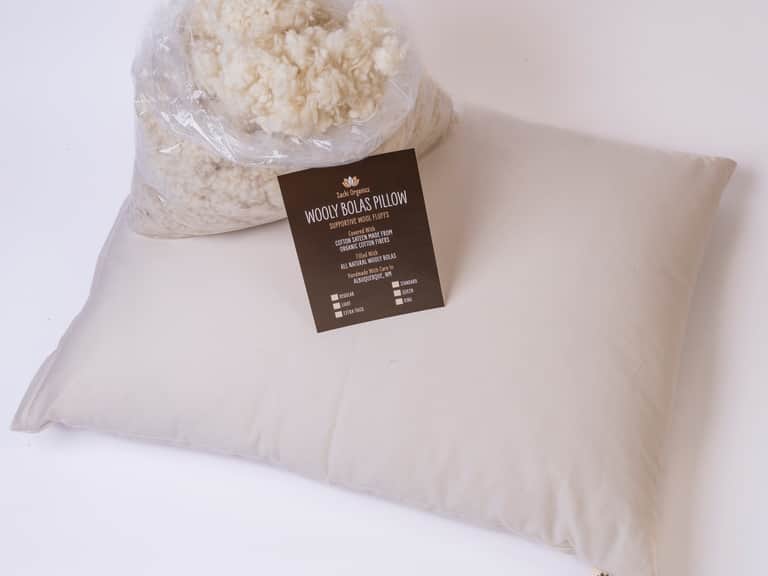
Once prepared, kapok is handled as a loose filling rather than a continuous textile. The fibers need to be distributed through the pillow in a way that achieves the desired volume and feel. The maker may use a measured quantity, divide the fill among compartments, or design an opening that allows future adjustment. These are construction choices, not inherent properties of the plant.
The distinction between raw fiber and finished fill is important. A description of kapok’s natural characteristics tells us something about the material; it does not, on its own, explain how a specific pillow is assembled. Details such as fill weight, casing design, internal baffles, and whether the insert is adjustable are product-specific.
Why kapok feels light and buoyant
The familiar impression of kapok is often one of airy loft: a pillow that seems to offer volume without the dense sensation of a compact, heavy fill. The fiber’s fine structure and the way loose fibers collectively trap space help account for that impression. In a pillow, many small fibers support one another within a fabric shell, creating a soft mass rather than a solid block.
That can make kapok appealing to people who prefer a lightweight, soft-feeling pillow. But “soft” and “supportive” are not opposites, and they are not simple synonyms either. Support depends on how much filling is present, how it is arranged, how readily the pillow compresses, and the sleeper’s body and position. A lofty pillow can still compress under the head; a pillow that feels springy in the hand may not provide the right height for every neck and shoulder.
Kapok is also often compared with down because both can feel light and lofty. The comparison is useful only up to a point. They are different materials, with different origins and structures, and their behavior in a pillow depends on the particular construction. Kapok is plant-derived; down is an animal-derived cluster filling. Neither label, by itself, establishes whether a pillow will be comfortable, durable, easy to clean, or suitable for a particular sleeper.
Breathability is another commonly discussed feature of natural fillings. A pillow’s ability to release heat and moisture depends not only on the filling but also on its cover, the density of the construction, room conditions, bedding, and the sleeper. It is reasonable to consider material as one factor in comfort, but broad promises about temperature or health should be treated cautiously.
Why adjustable kapok pillows make sense
Some kapok pillows are built with a zipper or another opening so that the user can remove or add filling. This design is especially practical for a material that is light and capable of creating a generous amount of loft. A pillow filled to one fixed level may feel too high or too full for one sleeper and too low for another. Adjustable construction gives the owner a way to alter the amount of fill rather than treating the original configuration as final.
Adjustment is best approached gradually. Removing a small amount at a time makes it easier to assess changes than emptying a large portion in one go. If filling is removed, store it in a clean, dry, sealed container rather than discarding it immediately. A pillowcase and a clean surface can help keep loose fibers contained during the process.
It is also worth checking whether a pillow uses one casing or multiple layers. A removable outer case may be intended for laundering, while an inner compartment holds the kapok. Opening the wrong layer, or assuming that the entire pillow can be washed because its cover can, may damage the filling or make it difficult to restore evenly. Product-specific instructions should take precedence over general advice.
Adjustability does not guarantee ergonomic suitability. Pillow height needs vary with sleeping position, body shape, mattress firmness, and personal preference. A side sleeper may need a different height from a stomach sleeper, while a back sleeper may prefer an intermediate profile. These are general considerations, not medical rules. Persistent pain, numbness, or sleep problems warrant advice from an appropriately qualified health professional rather than reliance on a pillow claim.
Pillow construction: the shell matters
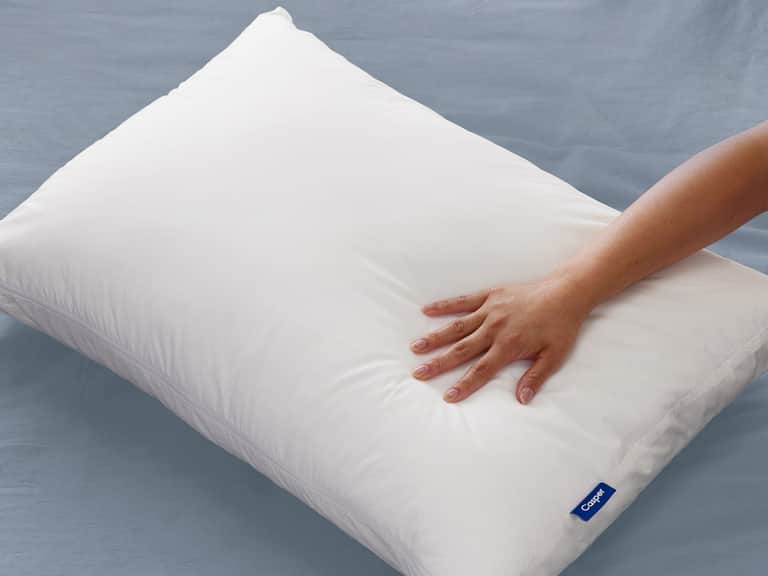
The pillow casing performs several jobs at once. It contains loose filling, shapes the pillow, and provides the surface that meets the pillowcase and, ultimately, the sleeper. A tightly woven fabric can help keep fine fibers inside. Seams and closures need to be secure, particularly when the fill is adjustable and the pillow is opened periodically.
Construction can also influence how the filling moves. A single open chamber lets the fill shift more freely. Internal divisions or stitching can help keep material in place, though they may limit how evenly a sleeper can redistribute it. There is no universally superior design: the right arrangement depends on the desired feel and intended use.
When evaluating natural pillow materials, it can help to separate four questions:
- What is the fill? Look for a clear description of the material and whether it is blended with anything else.
- How is the pillow built? Check for an adjustable opening, separate inner and outer covers, or compartmentalized construction.
- How much support does it offer in practice? Consider the pillow’s height, firmness, and your sleeping position rather than relying on the fiber name alone.
- What care does the maker recommend? Washing, spot cleaning, airing, and protecting a pillow are not interchangeable methods.
Those questions apply beyond kapok. Wool, latex, cotton, down, and other natural pillow materials all have their own structures and maintenance needs. Comparing materials responsibly means looking at the whole object—not just the attractive qualities of its filling.
Why kapok care differs from washable bedding
A pillowcase, a removable cover, and an inner pillow are different things. Pillowcases and some outer covers are designed to be laundered regularly. The fill itself may not be. Kapok pillows are often intended to be spot-cleaned rather than machine-washed, but care instructions vary by product and construction. The label or maker’s written guidance is the authority for a specific pillow.
Immersing a loose plant-fiber fill can create practical problems: it may be difficult to distribute and dry thoroughly, and prolonged dampness can compromise freshness. Even when the cover is washable, the inner core may require separate handling. If the instructions say not to wash the pillow, do not interpret that as a suggestion to put it through a gentle cycle anyway.
Routine protection is simpler than a rescue wash. Use a pillowcase and, where appropriate, a washable protector. Air the pillow in a dry, well-ventilated place according to the care guidance. If a spill occurs, address it promptly with a small amount of suitable moisture on the affected surface, taking care not to soak the filling. Let the pillow dry completely before putting it back into regular use.
Kapok is commonly described as water-resistant, but that does not mean a kapok pillow is waterproof or immune to spills. Water resistance refers to a material characteristic; the performance of an assembled pillow depends on its cover, seams, and exposure. It is safer to protect the pillow than to count on the filling to repel every liquid.
Keep heat and direct sunlight in mind as well. Care labels may advise against strong heat or prolonged exposure. Avoid placing the pillow near a radiator or using a hot dryer unless the maker explicitly says that the relevant component can be treated that way. Different covers and constructions may have different limits.
A practical reading of sustainability claims
Kapok’s botanical origin makes it relevant to conversations about natural materials, but the word “plant-based” is not a complete sustainability assessment. A material’s broader footprint depends on how it is grown or gathered, processed, transported, enclosed, used, and ultimately discarded. Reliable comparisons require information about those stages, not a conclusion drawn from the name of the fiber alone.
Consumers can look for transparent sourcing details, credible certification where applicable, and specific care guidance that could help extend the product’s useful life. Durability matters. A pillow that remains comfortable and serviceable for longer may be preferable to one that must be replaced quickly, though any environmental comparison needs evidence about the products in question.
It is also useful to distinguish a fiber’s potential from a claim about a finished pillow. A natural filling does not automatically make every component natural: the shell, thread, zipper, treatments, and packaging may be made from other materials. Clear specifications allow readers to see the complete construction and decide which attributes matter to them.
Questions to ask before choosing a kapok pillow
For readers considering kapok pillows, a short checklist can turn broad descriptions into practical information:
- Is the filling identified as kapok alone, or is it blended with another material?
- Can the loft be adjusted, and is the opening designed to be used by the owner?
- What are the pillow’s dimensions and, if given, its fill weight?
- Is the cover removable, and does that mean the cover only—or the entire pillow—can be washed?
- What cleaning method is recommended for spills and routine care?
- Are sourcing or organic claims explained with meaningful documentation?
- Does the stated pillow height make sense for your sleep position and mattress?
Answers may not reveal everything about how a pillow will feel after weeks of use, but they give a more dependable starting point than labels such as “cloud-like,” “eco-friendly,” or “perfect for everyone.” Comfort is personal; construction details are not.
The quiet logic of the kapok pillow
From the outside, a pillow is a simple object: a fabric case, a mass of filling, and a place for the head to rest. Kapok makes that simplicity more visible. Its seed-pod origin explains why the fiber arrives loose rather than spun into a fabric. Its airy feel explains why a small amount can create noticeable loft. Its handling needs help explain why makers may build pillows with adjustable fill and why care instructions can differ from those for ordinary washable bedding.
The journey from pod to pillow is therefore not just a story about a natural material. It is a lesson in how construction gives material its everyday meaning. The fiber supplies certain possibilities; the maker’s choices turn those possibilities into an insert; and the sleeper’s habits determine how that insert is adjusted and maintained.
For anyone exploring natural pillow materials, kapok is worth understanding on its own terms. It is light, plant-derived filling with a long association with padded goods—not a substitute for careful construction, clear care instructions, or a considered fit. The best starting point is not a promise of perfect sleep. It is a well-described pillow, a realistic understanding of its filling, and a willingness to adjust the loft until the shape suits the person using it.